
Mysterious midlife crisis’: Experts decode why stars switch to low activity state in time of life
The study provides a replacement theoretical underpinning for the unexplained breakdown of established techniques for measuring the age of stars past their time of life , and therefore the transition of solar-like stars to a magnetically inactive future.
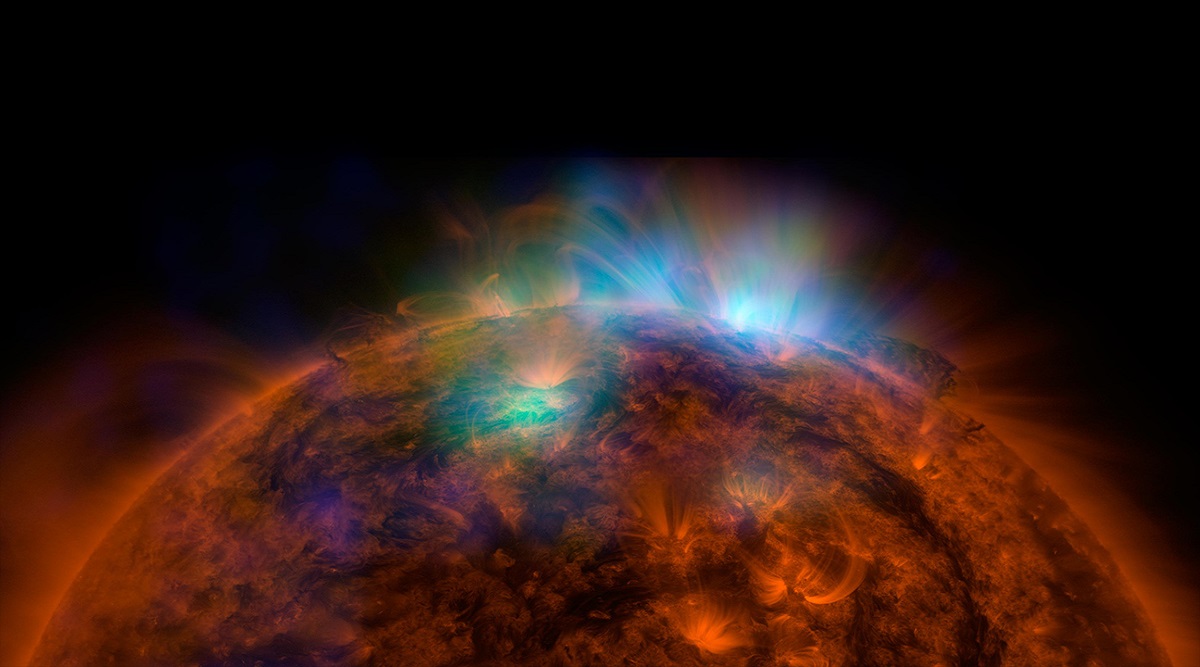
For some time now, it's been known that stars in their midlife can suddenly switch to a coffee activity state. Recent observations show that the sun now's much less active than other similarly aged stars.
According to a replacement research published on Wednesday in Monthly Notices of the Royal Astronomical Society: Letters, middle-aged stars can experience their own quite “midlife crisis”, experiencing dramatic breaks in their activity and rotation rates at about an equivalent age as our sun.
The new work, administered by Bindesh Tripathi, Prof Dibyendu Nandi, and Prof Soumitro Banerjee at IISER Kolkata provides a totally unique explanation for this mysterious ailment.
The study provides a replacement theoretical underpinning for the unexplained breakdown of established techniques for measuring the age of stars past their time of life , and thus the transition of solar-like stars to a magnetically inactive future.
Dr Nandi told The Indian Express that astrophysicists have struggled to elucidate these puzzling observations in stars that are of a uniform age to the sun. “Working with an undergraduate student from Nepal (now pursuing his PhD at University of Wisconsin) and colleague Soumitro Banerjee at IISER Kolkata, we've come up with a self-consistent explanation of these intriguing observations. We believe we've provided an answer to stellar midlife crisis,” Dr Nandi said.
Astronomers have long known that stars experience a process referred to as “magnetic braking” — a gentle stream of charged particles, referred to as the solar radiation , escapes from the star over time, carrying away small amounts of the star’s momentum . This slow drain causes stars like our sun to gradually hamper their rotation over billions of years. In turn, slower rotation results in altered magnetic fields and fewer stellar activity — the amount of sunspots, flares, outbursts, and similar phenomena within the atmosphere of stars, which are intrinsically linked to the strengths of their magnetic fields.
This decrease in activity and rotation rate over time is predicted to be smooth and predictable due to the gradual loss of momentum . The idea gave birth to a tool referred to as ‘stellar gyrochronology’, which has been widely used over the past 20 years to estimate the age of a star from its rotation period, read an official press release issued on Wednesday.
Recent observations, however, indicate that this intimate relationship breaks down around time of life . Using dynamo models of magnetic flux generation in stars, the team shows that at about the age of the sun, the magnetic flux generation mechanism of stars suddenly becomes sub-critical or less efficient. This allows stars to exist in two distinct activity states – low activity mode and active mode. A middle-aged star a touch just like the sun can often switch to low activity mode leading to drastically reduced momentum losses by magnetised stellar winds.
This hypothesis of sub-critical magnetic dynamos of solar-like stars provides a self-consistent basis for a diversity of solar stellar phenomena, like why stars beyond midlife don't spin down fast and up to date findings that the sun could also be transitioning to a magnetically inactive future.


0 Comments